

How to Measure Real Estate Campaign Leads, Conversion, and Cost per Lead
Build a practical real estate campaign funnel from total leads to qualified and converted enquiries, with budget and cost-per-lead context.
Real estate marketing reports often stop at the easiest number to collect: leads.
A campaign generated 200 enquiries. That sounds useful, but it does not tell a brokerage whether those enquiries were relevant, whether agents worked them, or whether any became real opportunities.
A practical campaign management funnel should connect marketing activity to sales progress:
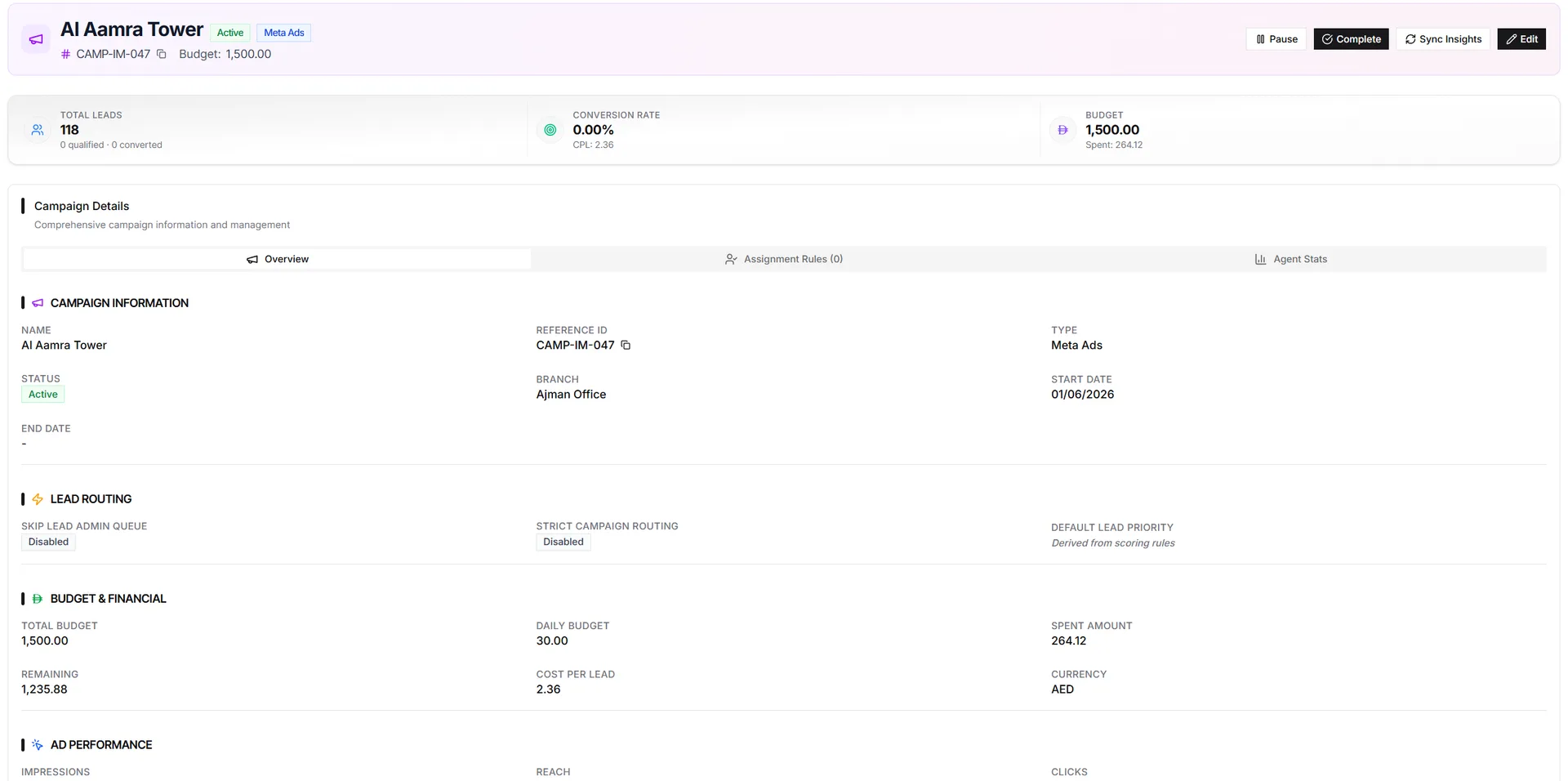
Total leads → Qualified leads → Converted leads → Cost per lead → Budget
Each stage answers a different management question.
Total leads: how much response did the campaign create?
Total leads measures the number of enquiries attributed to the campaign.
That attribution depends on clean source setup. Portal, Meta, TikTok, website, referral, event, and manual campaigns should be defined before leads arrive so each new record carries the right source and campaign.
Without that discipline, agents may still receive the leads, but marketing loses the ability to compare channels accurately.
Total lead count is a starting point—not a success metric on its own.
Qualified leads: did the campaign reach the right audience?
A qualified lead meets the agency’s working criteria. Depending on the campaign, that may include:
- realistic budget
- relevant location
- suitable property type
- credible buying or renting timeline
- reachable contact details
- genuine interest in the advertised inventory
The ratio of qualified leads to total leads gives a clearer view of campaign quality.
For example, two campaigns may each create 100 enquiries. If one produces 40 qualified leads and the other produces 10, the first is delivering a much stronger audience even before a deal closes.
This is why campaign reporting should read actual lead statuses from lead management, rather than relying only on numbers returned by the advertising platform.
Converted leads: did marketing create pipeline?
In IRM365, conversion means the lead has progressed into an opportunity tied to specific inventory.
That is an important dividing line. A qualified lead is worth working; a converted lead has entered the sales pipeline.
Tracking converted leads against the campaign shows whether marketing is creating real sales work instead of only generating contact details.
It also helps expose a sales-process problem. A campaign can produce a healthy volume of qualified leads but few conversions if:
- follow-up is slow
- suitable inventory is unavailable
- agents do not create opportunities consistently
- qualification is too loose
- the campaign promise does not match the actual offer
Cost per lead: what did each enquiry cost?
The basic formula is:
Campaign spend ÷ Total leads = Cost per lead
If a campaign spends AED 10,000 and produces 100 leads, the cost per lead is AED 100.
That number is useful for media efficiency, but it should always appear beside lead quality and conversion.
A low cost per lead can be expensive in practice if nearly every enquiry is irrelevant. A higher cost per lead may be worthwhile when the campaign attracts qualified buyers for high-value inventory.
The stronger comparison is therefore:
- cost per total lead
- qualified-lead rate
- conversion rate
- eventual won value
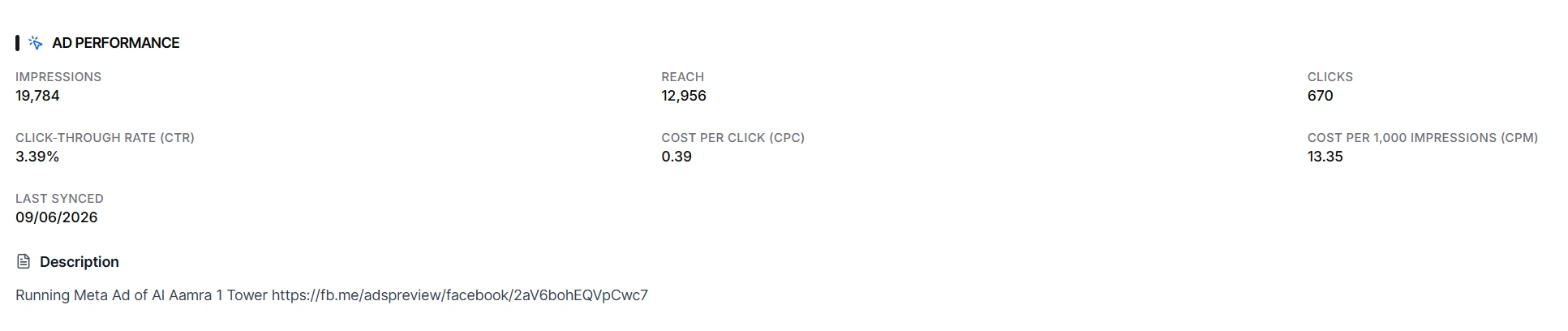
IRM365 can sync supported platform insights such as impressions, clicks, spend, and CTR, then connect that marketing context to the CRM leads and conversions the campaign produced.
Budget: are you pacing spend deliberately?
A campaign budget should not appear only as a number in the setup form. A spend bar makes the relationship between planned budget and current spend visible at a glance.
That helps answer:
- Is the campaign spending too quickly?
- Is it under-delivering despite available budget?
- Is lead quality improving or declining as spend increases?
- Should budget move to another source?
Budget pacing is most useful when reviewed with the funnel. Spending 80% of budget is not automatically good or bad; the important question is what that spend produced.
Keep lifecycle status visible
Campaigns also need a clear operating status:
- Draft: configured but not ready to accept integration leads
- Active: currently receiving and attributing leads
- Paused: temporarily stops new integration ingestion while preserving existing leads
- Completed: closed for new activity and retained for reporting
Status colours help teams scan the campaign list quickly, but the underlying rules matter more. Pausing a campaign should not delete the leads already captured, and completing it should preserve the record for historical comparison.
Search the leads behind the metric
A dashboard number is only useful when the team can inspect the records behind it.
Campaign lead search should find an enquiry by:
- name
- lead reference
- phone
- status
- source
- owner
This is especially useful when marketing and sales investigate a discrepancy. If the campaign reports a conversion but the team cannot locate the lead, trust in the funnel disappears.
The same principle applies to every metric: make the total visible, then make the underlying leads reachable.
Separate platform mapping from CRM attribution
Lead-ad platforms use their own campaign IDs, form IDs, and question fields. The CRM uses fields such as name, phone, email, budget, source, and campaign.
Field mapping connects the two.
For Meta campaigns running across eligible Facebook and Instagram placements, or for TikTok lead forms, each platform answer should map into the correct IRM365 lead field. Once the record is created, the normal duplicate, scoring, and assignment workflows can run.
This is why campaign setup is more than entering a budget. It defines how an external form becomes a usable CRM record.
Review campaign performance in two meetings
Marketing and sales need related—but different—reviews.
Marketing review
Focus on:
- spend and budget pacing
- impressions, clicks, and CTR where available
- total leads
- cost per lead
- qualified-lead rate by source
Sales review
Focus on:
- speed to first contact
- assigned versus unassigned leads
- overdue follow-ups
- qualified leads
- opportunities created
- converted and won outcomes
The campaign record connects both meetings. Marketing sees what happened after the form submission, while sales sees the source and cost behind the leads they received.
Avoid common reporting mistakes
Comparing lead volume without quality
The campaign with the most leads is not automatically the best campaign.
Using ad-platform conversions as CRM conversions
A platform conversion may mean a submitted form. A CRM conversion should mean the lead progressed into the sales workflow.
Ignoring status changes after ingestion
Campaign totals should reflect current lead statuses. When a lead becomes qualified or converted, the campaign funnel needs to update from the actual CRM record.
Hiding the records behind charts
If a team cannot open the leads behind a metric, it cannot verify or improve the result.
The bottom line
A useful real estate campaign report connects spend to the full lead journey.
Total leads show response. Qualified leads show audience quality. Converted leads show pipeline creation. Cost per lead shows acquisition efficiency. Budget shows pacing.
IRM365 brings those figures together with campaign status, platform mapping, assignment linkage, and searchable lead records—giving a real estate agency a campaign funnel both marketing and sales can use.
The IRM365 team at VoxaSoft builds real estate CRM software for UAE agencies, brokerages, and property developers. We write about lead management, sales pipelines, finance, and UAE property operations from the workflows we ship into the product every release.
More about IRM365 →Want this workflow inside your agency?
See how IRM365 handles lead capture, activities, agreements, lease operations, finance, and reporting in one workspace.